

What Is Full-Stack Web Development? A Complete Guide
If you have ever worked on a website project or spoken to a developer, you have probably heard the term full-stack web development. It sounds impressive, slightly technical, and often confusing for people who are not deeply involved in development.
What does full-stack actually mean? Is a full-stack developer better than a front end or back end developer? And more importantly, when does full-stack development make sense for your business or project?
This guide breaks down full-stack web development in a simple, practical way so you understand what it is, how it works, and when it is the right choice.
Understanding Full-Stack Web Development in Simple Terms
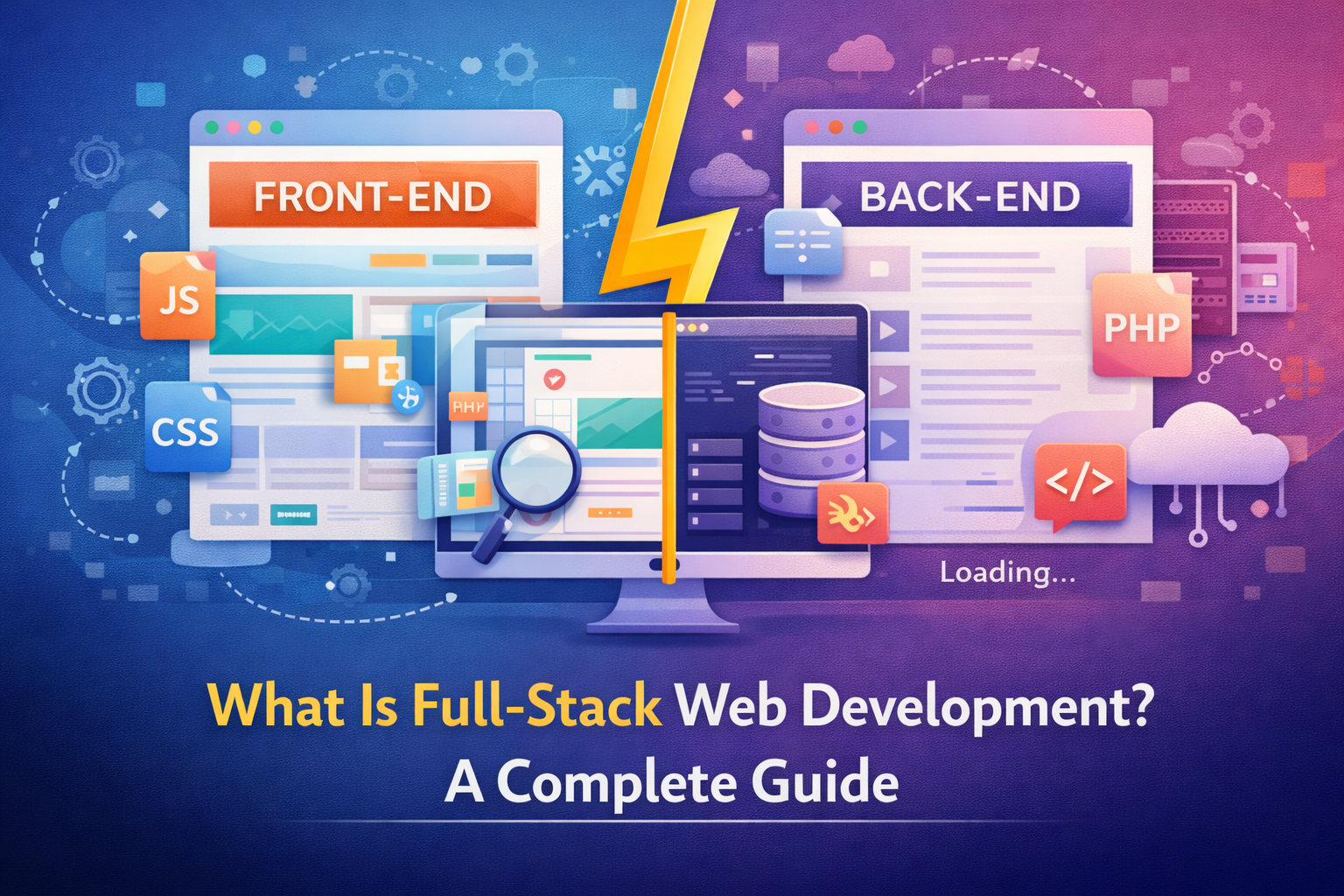
Full-stack web development refers to building both the front end and the back end of a website or web application. A full-stack developer works across the entire technology stack that powers a website.
In simple terms, full-stack development covers:
- What users see and interact with
• How the website processes data
• How information is stored and retrieved
• How everything connects behind the scenes
Instead of focusing on just one layer, full-stack development handles the complete picture.
Front End and Back End Explained
To understand full-stack development, it helps to know the two main parts of a website.
Front End Development
The front end is everything users see in their browser. It includes the layout, design, buttons, forms, and navigation.
Front end development focuses on:
- Page structure
• Visual styling
• Interactions and animations
• Responsive behavior across devices
The goal is to create a smooth and intuitive user experience.
Back End Development
The back end powers everything behind the scenes. Users do not see it, but it is essential for functionality.
Back end development handles:
- Servers and databases
• User authentication
• Data processing
• Business logic
• API connections
Without the back end, a website would not be able to store data, process forms, or manage users.
What Makes Development Full-Stack
Full-stack development combines both front end and back end responsibilities into one workflow.
A full-stack developer understands:
- How user interfaces are built
• How data flows through the system
• How servers communicate with databases
• How front end and back end connect
• How to debug issues across the entire system
This holistic understanding allows full-stack developers to build complete solutions rather than isolated components.
Common Technologies Used in Full-Stack Development
Full-stack development involves multiple technologies working together.
Front end technologies often include:
- HTML for structure
• CSS for styling
• JavaScript for interactivity
Back end technologies may include:
- Server side languages
• Databases for data storage
• APIs for communication
Frameworks and tools help connect these layers and speed up development.
You do not need to master every tool to understand full-stack development. What matters is knowing how the pieces fit together.
Why Businesses Choose Full-Stack Development
Many businesses prefer full-stack development because it simplifies the development process.
Key benefits include:
- Faster development cycles
• Better communication between components
• Fewer handoffs between teams
• Easier troubleshooting
• More cohesive architecture
For startups and growing businesses, full-stack development can be especially efficient.
When Full-Stack Development Makes the Most Sense
Full-stack development works best in certain scenarios.
It is ideal when:
- You are building a new product or platform
• The project scope is flexible or evolving
• You want faster iteration and updates
• Budget and team size are limited
• Close collaboration is required
For complex enterprise systems, specialized teams may still be necessary. But for many projects, full-stack development offers the right balance.
Full-Stack Development vs Specialized Roles
Some people assume full-stack developers replace front end or back end specialists. That is not always true.
Specialists offer deep expertise in one area. Full-stack developers offer breadth and integration.
The right choice depends on:
- Project complexity
• Timeline
• Budget
• Team structure
Many successful teams use a mix of full-stack developers and specialists.
How Full-Stack Development Impacts Speed and Scalability
Because full-stack developers understand the entire system, they can make smarter architectural decisions early.
This helps with:
- Reducing technical debt
• Improving performance
• Scaling features smoothly
• Avoiding mismatched components
A well built full-stack application grows more easily over time.
Learning Full-Stack Development as a Beginner
For beginners, full-stack development can seem intimidating. The key is not to learn everything at once.
A practical learning path includes:
- Understanding basic front end concepts
• Learning how servers work
• Exploring databases
• Practicing small projects
• Connecting front end and back end
Over time, the pieces start to make sense together.
Is Full-Stack Development Right for Every Project
Not every project needs full-stack development.
Small static websites may not require back end logic. Large enterprise systems may benefit from specialized teams.
The goal is to match the development approach to the project needs rather than forcing one model everywhere.